
* başlığı gir
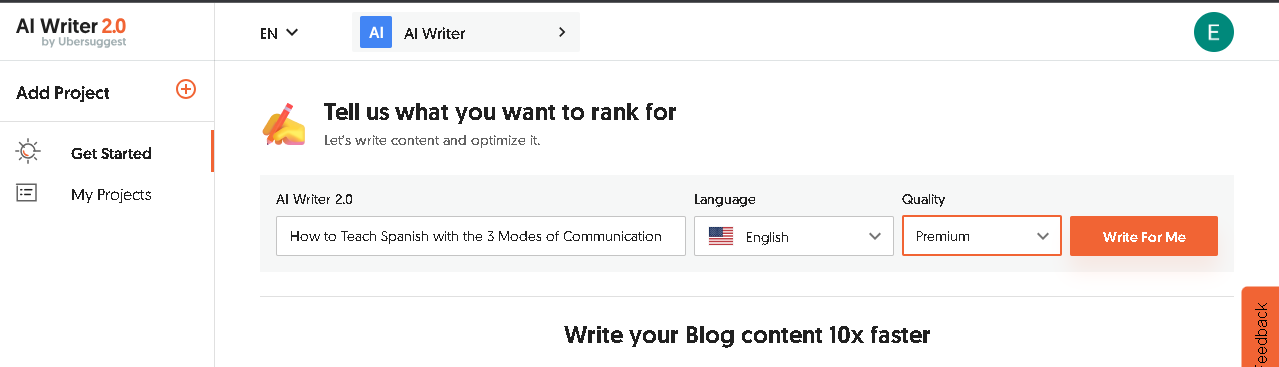
* Önerdiği başlığı seç
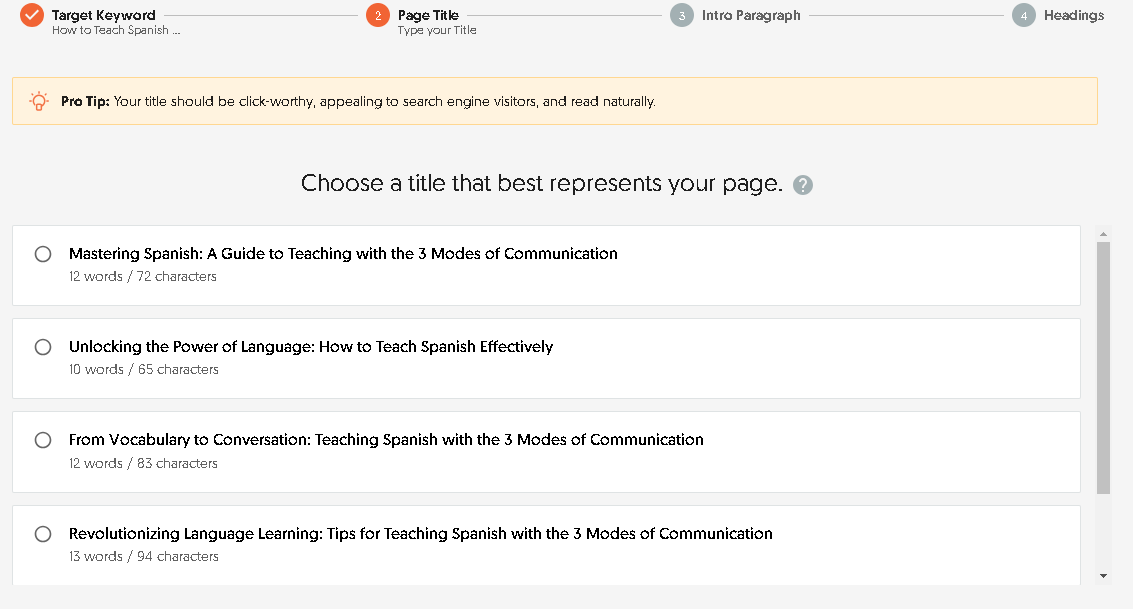
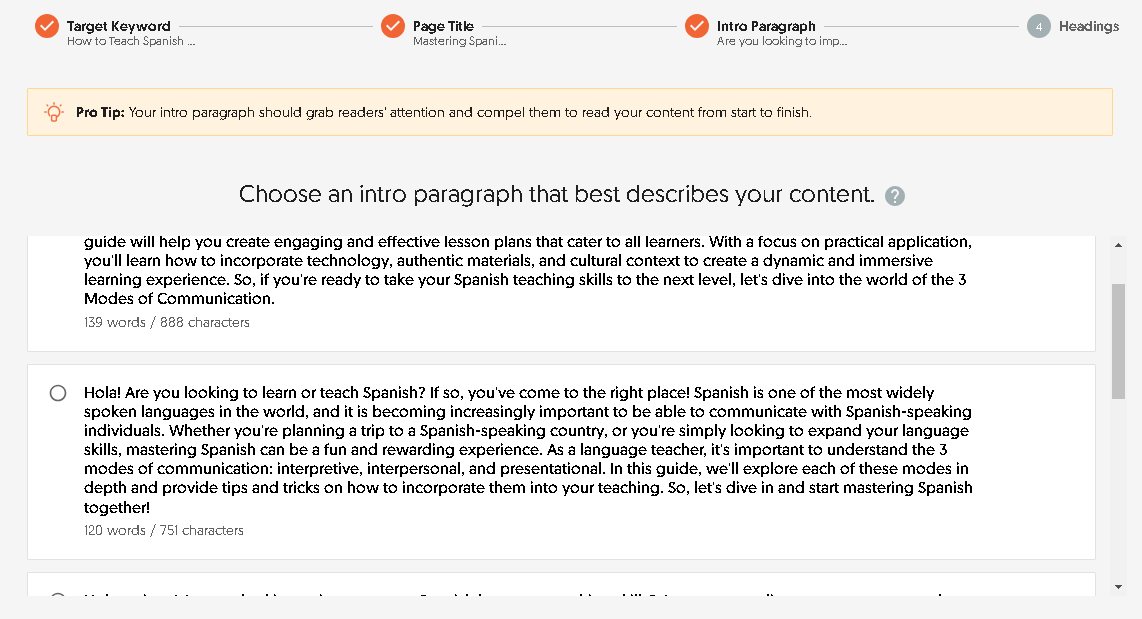
önerilen giriş paragrafını seç
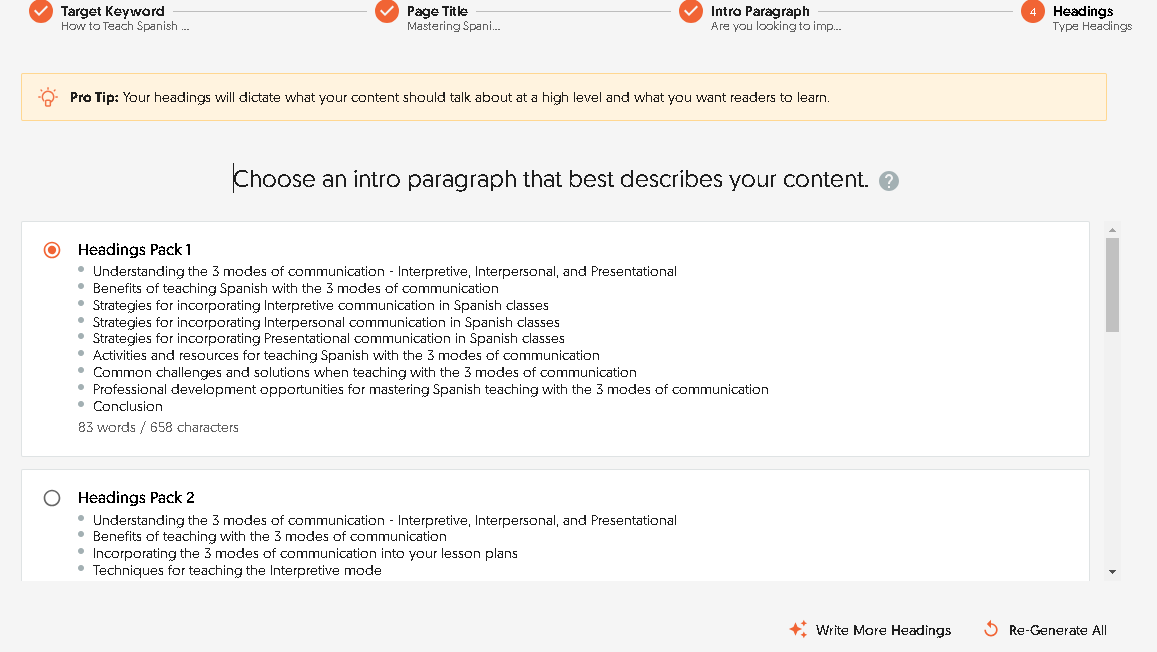
*alt başlıkları belirler
hazır. Biraz zor bir konu seçtim, konuya ekledim. Spoyler içinde
link: https://app.neilpatel.com/aiwriter/document-editor
Mastering Spanish: A Guide to Teaching with the 3 Modes of Communication
Are you looking to improve your Spanish language teaching skills? Do you want to help your students become confident and proficient in their communication abilities? Look no further than the 3 Modes of Communication. This comprehensive guide will provide you with the tools and strategies you need to master the art of teaching Spanish using the 3 Modes of Communication: Interpretive, Interpersonal, and Presentational. Whether you're a seasoned educator or just starting out, this guide will help you create engaging and effective lesson plans that cater to all learners. With a focus on practical application, you'll learn how to incorporate technology, authentic materials, and cultural context to create a dynamic and immersive learning experience. So, if you're ready to take your Spanish teaching skills to the next level, let's dive into the world of the 3 Modes of Communication.
Understanding the 3 modes of communication
The 3 Modes of Communication are Interpretive, Interpersonal, and Presentational. These modes were introduced by the American Council on the Teaching of Foreign Languages (ACTFL) to provide a framework for language learning and teaching.
**Interpretive Communication** refers to the ability to understand spoken and written messages from others. This mode requires the learner to have good listening and reading skills. It is the most passive mode of communication, as the learner is not required to produce a response.
**Interpersonal Communication** refers to the ability to engage in a conversation with others. This mode requires the learner to be able to speak and understand spoken messages. It involves a two-way communication process where both parties are actively involved in producing and interpreting messages.
**Presentational Communication** refers to the ability to produce a message for an audience. This mode requires the learner to be able to write and speak effectively. It involves a one-way communication process where the learner produces a message for others to interpret.
Benefits of teaching Spanish with the 3 Modes of Communication
Teaching Spanish with the 3 Modes of Communication has several benefits. First, it provides a comprehensive approach to language teaching that addresses all aspects of communication. This ensures that learners develop a well-rounded set of language skills. Second, it promotes an interactive and engaging learning experience that allows learners to actively participate in the language learning process. Finally, it allows learners to develop a deeper understanding of cultural context and the nuances of language use.
Strategies for incorporating Interpretive communication in Spanish classes
Incorporating Interpretive communication in Spanish classes can be done in several ways. One effective strategy is to use authentic materials such as news articles, videos, and podcasts. These materials provide learners with exposure to real-life language use and help them develop their listening and reading skills. Another strategy is to use comprehension activities such as multiple-choice questions and fill-in-the-blank exercises. These activities help learners develop their ability to understand spoken and written messages.
A third strategy is to use technology to enhance Interpretive communication. For example, online resources such as Duolingo and Quizlet provide learners with interactive activities that focus on listening and reading skills. Language learning apps such as Babbel and Rosetta Stone also provide learners with opportunities to practice Interpretive communication.
Strategies for incorporating Interpersonal communication in Spanish classes
Incorporating Interpersonal communication in Spanish classes requires a focus on conversation skills. One effective strategy is to provide learners with opportunities to practice speaking and listening in pairs or small groups. This can be done through role-playing activities, debates, and discussions. It is important to provide learners with feedback and correction during these activities to help them improve their conversation skills.
Another strategy is to use authentic materials such as interviews, podcasts, and videos. These materials provide learners with exposure to real-life conversation and help them develop their listening and speaking skills. It is important to provide learners with activities that focus on developing both their receptive and productive conversation skills.
Strategies for incorporating Presentational communication in Spanish classes
Incorporating Presentational communication in Spanish classes requires a focus on writing and speaking skills. One effective strategy is to provide learners with opportunities to present their ideas to an audience. This can be done through oral presentations, debates, and speeches. It is important to provide learners with feedback and correction during these activities to help them improve their presentation skills.
Another strategy is to use authentic materials such as articles, reports, and essays. These materials provide learners with exposure to real-life language use and help them develop their writing skills. It is important to provide learners with activities that focus on developing both their receptive and productive writing skills.
Activities and resources for teaching Spanish with the 3 modes of communication
There are several activities and resources that can be used to teach Spanish with the 3 Modes of Communication. One effective activity is to use a news article or video as the basis for a lesson. Learners can read or watch the material and then answer comprehension questions. This activity focuses on Interpretive communication.
Another effective activity is to use a role-playing exercise to practice Interpersonal communication. Learners can practice having conversations in pairs or small groups based on a given scenario. This activity provides learners with opportunities to practice their conversation skills in a safe and supportive environment.
For Presentational communication, learners can be asked to create a presentation or write an essay on a given topic. This activity allows learners to practice their writing and speaking skills while also developing their ability to produce a message for an audience.
There are also several resources available online that can be used to teach Spanish with the 3 Modes of Communication. Duolingo, Quizlet, and other language learning apps provide learners with interactive activities that focus on all three modes of communication. The ACTFL website also provides resources and guidelines for teaching with the 3 Modes of Communication.
Common challenges and solutions when teaching with the 3 modes of communication
Teaching with the 3 Modes of Communication can present several challenges. One common challenge is finding authentic materials that are appropriate for learners at different proficiency levels. Another challenge is providing learners with opportunities to practice all three modes of communication consistently.
To address these challenges, it is important to use a variety of materials and resources that cater to learners at different proficiency levels. It is also important to provide learners with opportunities to practice all three modes of communication consistently. This can be done through a variety of activities and exercises that focus on each mode of communication.
Professional development opportunities for mastering Spanish teaching with the 3 modes of communication
There are several professional development opportunities available for teachers who want to master Spanish teaching with the 3 Modes of Communication. The ACTFL provides workshops and conferences that focus on language teaching and assessment. There are also several online courses and webinars available that cater to teachers at different proficiency levels.
In addition, teachers can collaborate with other educators to share ideas and strategies for teaching with the 3 Modes of Communication. This can be done through professional organizations such as the American Association of Teachers of Spanish and Portuguese (AATSP).
Conclusion
Teaching Spanish with the 3 Modes of Communication provides a comprehensive approach to language teaching that addresses all aspects of communication. Incorporating Interpretive, Interpersonal, and Presentational communication in Spanish classes requires a focus on different skills and strategies. By using a variety of materials and resources, and providing learners with consistent opportunities to practice all three modes of communication, teachers can create an engaging and effective learning experience for their students. With the right tools and strategies, mastering Spanish teaching with the 3 Modes of Communication is within reach for all educators.